Control – the seemingly endless battle.

We were going thorough a truly terrible few days.
Relentless anger, door slamming and swearing, and the endless obsession with a need for an expensive IPhone.
Anxiety peaked on the return home from school and lasted well into the evening.
We’d had similar before, but this was worse than usual.
Normally, a different activity, change of scene or even a night’s sleep would ‘reset the clock’ and help us all regulate.
It was gruelling, and rather like The Battle of Britain in World War II, we had no idea if we were at the beginning of the end, or the end of the beginning.
We dreaded the weekend, as the lack of structure just looked like an endless 48 hours of anger management and destruction control.

Wars are exhausting, You never know when they’re going to end.

On Friday evening, the IPhone issue was raised, again.
We’d said ‘no’ for, what we considered to be a very reasonable set of reasons.
In no particular order, these were:

  1. He already had a phone.
  2. He broke everything, absolutely everything, either wilfully or absentmindedly.
  3. He was 11 and too young.
  4. We didn’t have the £853.
  5. You can’t give in to a kid’s tantrums. If you give an inch, they’ll take a mile, and as adults, we were in control. We considered this to be a sacrosanct pillar of parenting.

On Friday evening at 11pm, the battle was still raging.
I’d not been able to watch Gardener’s World or the Snooker.
Things were serious.

In a moment of quiet reflection, whilst hiding in the toilet, I considered the situation.
What we were doing, was not working.
This kid’s stamina and resilience was greater than ours. He had limitless amounts of adrenaline on his side. We were spent.

“I have an idea.” I posited, in the most casual of manners.
“There may be a phone at The Cash Converter. Would anyone like to come with me and have a look?”
The Little Man’s ears pricked up.
“Yes, this may be a solution. We should drive there, this very moment.” ( These weren’t his actual words).
I had banked on this reaction.
“Great. Get your coat and shoes on. We will go now. However, we can’t drive as I’ve had a beer and that is illegal. We will walk, but we must go now.”
The order of what I said was planned and considered.
I knew the urgency would appeal to him.

As long as you aren’t actually after anything specific, there aren’t many shops more exciting than a Cash Converter.

We set off.
I hadn’t had a beer. Drinking and managing anger never ever go well together.
I wanted us to walk and I took the longest route possible.
I knew exercise would dissipate some of the adrenaline in his body.
I’d learnt that on a course.

An hour later, we arrived at The Cash Converter.
It was shut.
I had anticipated this too.
After all, it was 1.00am.
The Little Man kicked the shutter.

“I’ve got another idea. We can make a phone. We have everything we need at home. We can print out a photo of the phone we want. We can use Amazon packaging from the recycling bin. We can measure it all out and cover it in sellotape. Will you help me?”
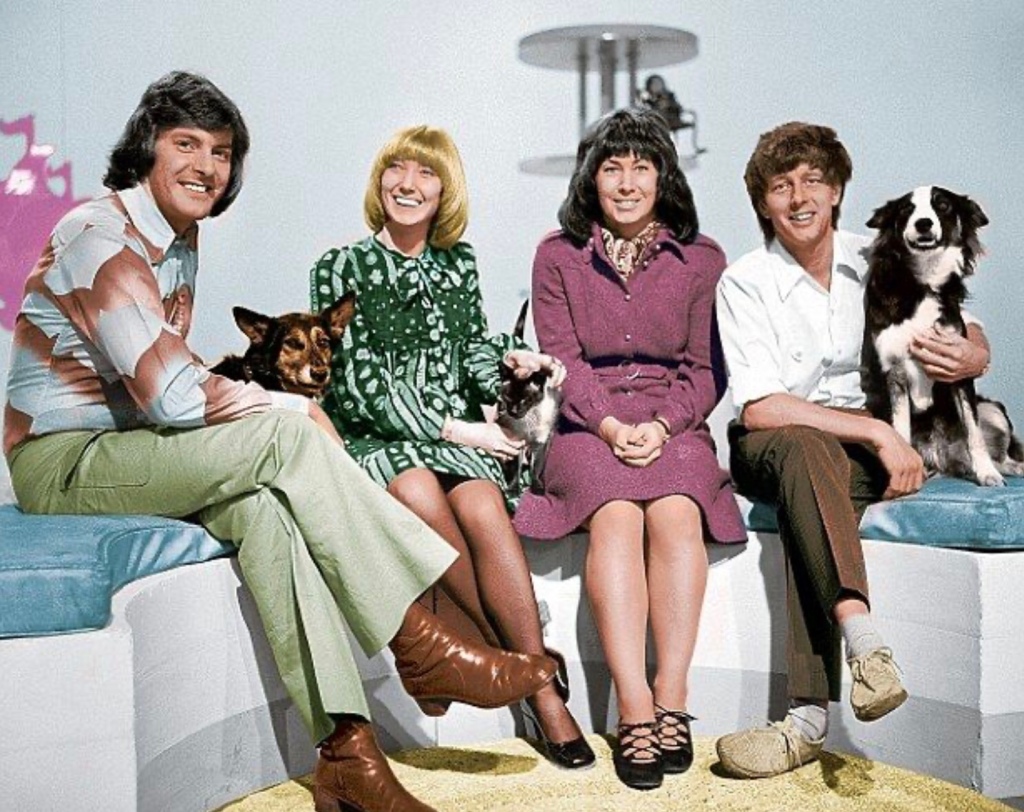
There are three ways to determine someone’s age; Carbon dating, cut them in half and count the rings, or ask them to name their favourite Blue Peter Presenter.

The use of “we” was important and deliberate.
By 2.00am, we were back home, printing, cutting, sticking and gluing.
I’m no Blue Peter presenter, but what we created was pronounced ‘good enough’.
Every parent of any type needs to know that ‘good enough’ is the only real measure of success.
By 2.30am, we were all tucked up and asleep.

“I don’t know why I’m so obsessed with phones. Maybe there was nothing else to play with when I was with my birth Mum. Or maybe she was always on her phone and ignored me. I’ll never know. There’s no one to ask.” For a kid with an autistic diagnosis, The Little Man can be remarkable astute.

On the following day, Saturday, The Little Man was going to a party.
He’d had an invitation from a kid in his class.
The Penny dropped.
He was scared.
He was scared that there would be strangers at the party.
He was scared that he wouldn’t recognise the food and that he wouldn’t know where the toilet was.
He was scared there might be a dog.
He was scared we would leave him, and he would be alone.

We think certain obsessions, such as phones, are merely subconscious strategies to keep us close during times of anxiety.


The week’s battles had been his attempt to keep us close.
Who had control in this situation?
Me? Us? Him?
No, Fear was in control, fear masquerading as anger.

If you can deal with the fear, the rest, is relatively easy.

Social Workers are (mostly) great

Kiri Pritchard-McLean is a rudely hilarious stand up comedian. she also fosters for her Local Authority.

My wife and I went on a night out.

If you’ve got a good support network you can occasionally do that sort of thing.

We went to see a comedian.

He was pretty funny, but towards the end of his set, he’d clearly run out of material and begun to make fun of the crowd.

He’d picked on a couple of people and done a good job in making them looking silly in front of the 200 strong crowd.

Inevitably, he picked on me.

‘Alright mate, what’s your name and what do you do?’

There’s a temptation to try and be smart when you’re in this situation, but then you’d only look more stupid and you haven’t got a microphone anyway.

It’s best just to suffer being the butt of the joke and smile graciously.

‘I’m called Phil and I’m a Foster Carer.’

The comedian rolled his eyes and looked around the room.

He paused, to build the tension.

‘Typical, just typical. I’m here to make people laugh. People have paid good money to hear some jokes and what happens?…What happens? I pick on a Foster Carer. A Foster Carer. How can I make fun of you? You’re bullet proof. Thanks for all you do.’

I got a round of applause.

I’m a massive show off as you’ll gather from these blogs, and I generally love attention.

Foster Carers, in our experience, are generally highly regarded by society as a whole.

We’re not quite Saints, but if anyone has an insight into what we do, they generally admire us.

We do something that is probably difficult and society benefits.

It’s different for Social Workers.

They appear to be ‘damned’ whatever they do.

They’re either accused of interfering too much and too soon, or not getting involved quickly enough.

If you foster, you’ll meet lots of  Social Workers.

You’ll have one, and any child you foster will have one.

As in all professions, they’ll have time off on holiday, time off sick and sometimes they’ll leave for pastures new.

They’ll be managing a case load.

One Foster Kid called Social Workers ‘ladies with lanyards’. Some of these ladies are men.

A case load means lots of kids, lots of Foster Carers, lots of paperwork and lots of deadlines.

They’ll have gone through pretty rigorous training, and they’ll be supervised by Senior Social Workers.

They’ll also be managing their own relationships, kids, and all the usual domestic stuff that everyone does. 

Sometimes their cars break down and their phone screens smash.

Some are brilliant.

And some are not brilliant.

In our experience, most are good enough most of the time.

If you can, invest in your relationship with the Social Workers.

It’ll be easier for you, easier for them and easier for the kids.

Give them tea and biscuits.

One of our favourite Social Workers was Elaine, although Gerry is a close second.

Elaine spoke in a way I understood.

She didn’t use too much jargon.

She explained things clearly and coherently.

She answered our emails and messages as quickly as she could.

She was patient with me when I didn’t understand what was going on.

Without patronising us, Elaine helped us be better Foster Carers.

She advised us on daily records, training, safeguarding and all sorts of childcare tips.

She recognised that we knew the kids better than she did.

However, she helped us recognise that we are looking after the kids on behalf of the State.

Social Workers, Solicitors, Panels populated by Independent Members, Judges and possibly all sorts of other people would ultimately have the final say about what happens to the kids.

All these people are working within regulations, standards and laws.

No big decision is made by one single person.

The Foster Carer is an important part of the system, but you have to understand that you are just part of the system.

Gerry must also get a nod.

Gerry liked his tea with a splash of milk and would eat any biscuit he was offered. I respected his low maintenance approach.

He was one of our Foster Kid’s Social Workers.

He’d developed a pretty good relationship with the kid which was no mean feat.

Gerry and I were chatting in the posh lounge about progress and care plans.

It’s always tricky to chat about a kid when they’re in the house, and they’ve worked out that they’re the focus of the discussion.

The lounge door flew open, and a kid appeared, brandishing a potato masher in a threatening manner.

I don’t know how much damage you can do with a potato masher, and quite frankly I don’t want to find out.

‘What are you saying about me?’

Gerry looked at me, and I looked at him.

According to the chain of command, Gerry was in charge, but Gerry knew I was far more likely to be able to deescalate the situation than he could.

Gerry took control, but gave me authority.

‘It’s not a secret. Would you like Phil to explain? He will probably do a better job than me.’

Within a few minutes, the utensil was back in the kitchen and the kid was satisfied with our answers.

Gerry and I had worked together well.

Gerry respected me and I respected him.

That’s when fostering works best.

Will fostering or adoption ruin my marriage?

For the least few months, my wife has done the morning routines entirely on her own.

I’ve never been skiing, surfing or snowboarding. If I need an adrenaline rush, I’ll do the school run.

She begins the process with a gentle ‘good morning’, and then ascends to the urgent encouragement required to get the Little Man in the shower, get dressed, stop making Tik Toks and eat his toast.

She receives the brunt of any mood.

If anyone is sworn at, it is my wife.

She looks out for his transport to school, and ushers him out the door.

She reminds him to take his water bottle and his front door key.

My job is to stay out the way.

On easy days, this is easy.

It’s harder to pretend to be invisible when he’s ‘effing and jeffing’.

This division of labour has been discussed and planned by my wife and me.

We know the mornings can be delicate to the point of fragile, and we need to follow a pretty strict routine.

If I should try to help by making the toast, I would be creating a point of conflict.

Almost inevitably, any toast I would make, would be too warm, too soft or incorrectly cut.

 We would then have to deescalate and reregulate.

There’s no time for that when we are keeping to a schedule.

I’m going to take a crazy wild guess that this is not the home of a traumatised kid.

On other occasions, I am the lead parent.

This is not a gender issue, this is purely for practical issues.

If all is well, we can tag team or parent together.

Leaving the house and going to school, or anywhere else, is often known in the trade as a ‘transition’.

These are often the most stressful points of the day.
A kid who is used to chaos, aggression, disruption and possibly violence, may well try and recreate this in your home.

It’s, quite literally, their way of making themselves feel at home.

This may well mean winding you up individually, collectively, and possibly, purposefully driving a wedge between you.

If there is already a crack in your relationship, it may well be widened.

One of you may become ‘the preferred parent’ which will be exhausting.

The other parent may feel guilty for not ‘pulling their weight’.

This may lead to tension, and your relationship will suffer.

During ‘The winter war of attrition’ as we know it, our Foster Kid did everything in his power to bring chaos and disorder.

Hours of moodiness became days of anger, and then weeks of meltdowns.

The weeks then became months.

It nearly wrecked us.

However, we are still together and we did learn a lot.

I think the child in question had been triggered by the time of year.

Something deep inside him thought the packing away of The Christmas Tree, the short days, and miserable weather meant he would be leaving a home he’d actually begun to enjoy.

Rather than have safety taken from him, he decided to take the proactive step of destroying it himself.

Each night, after a fretful evening of what may loosely be called ‘the bedtime routine’, my wife and I would regroup in our bedroom.

We learnt that one of us managing him on their own worked marginally better than both of us.

We learnt that some routines brought marginally more calm than others.

We scanned the family schedule for potential flash points.

We asked wiser, older heads for their opinions.

We resolved to get through the next hour, the next day, and then the next week.

Gradually, at a glacial pace, things improved.

Outsource any tasks you can. Don’t be too proud to employ a cook, a cleaner, a butler and a pastry chef. Grab any respite opportunities you can.

During such a time, our relationship was put under tremendous pressure, but it probably emerged stronger.

There was absolutely no time for petty debates and disputes.

There was no space for the nonsense of adult sulks or passive aggression.

Any debate between us has to be fast, furious and to the point.

Any grievance has to be quickly and clearly explained. The other partner has no time to brood, but needs to quickly apologise and alter their behaviour.

We don’t fall out over small stuff, because, to massively mix my metaphors, we have much much bigger fish to fry.

Fostering or adopting children that have been through significant trauma will test your relationship.

Please invest time in self-care and don’t be shy about leaning on your support network.

Self care can take many forms. You’re unlikely to have the time to sit on a tightrope in the Himalayas. You’ll probably lock yourself in the bog and have a cry. It’s just as effective.

Foster Carers and Adopters can be married, in a partnership, single, widowed and of any sexual orientation.

Letterbox Contact: Just because you haven’t got a family, doesn’t mean you haven’t got a family.

Pretty much every male in our family is colour blind. It’s in our DNA. Our adopted son has perfect colour vision. This is akin to a super power and we are in awe of him.

Fostered and adopted kids have a relationship with their birth family.

They may have been ‘removed at birth’.

They may have no recollection of ever meeting them.

They may hate them.

They may eulogise their memory.

They may never mention them and resist any attempt to revisit their past.

However, birth family exist, even if they’ve passed away.

Birth family exists for Foster Carers and adopters too.

Once or twice a year, we receive Letterbox Contact Letters from Birth Family.

The Birth Family send their cards to a Social Services Office.

A Social Worker opens the cards, checks them, and then repackages them in special Council envelopes.

The cards are sent on to us.

We recognise the cards when they arrive, and tend to open them when the relevant child is not in the vicinity.

We are meant to get one at Christmas and one at Birthday.

They tend to arrive not quite on time.

Some of what is written is redacted, which basically means scribbled out and made illegible.

The card or letter can give no clue as to how birth family could be contacted.

First names rather than ‘Mum and Dad’ are used.

There are declarations of love.

I’ve no idea what Birth Family are meant to write and how they’re meant to write it.

It must be awful for them.

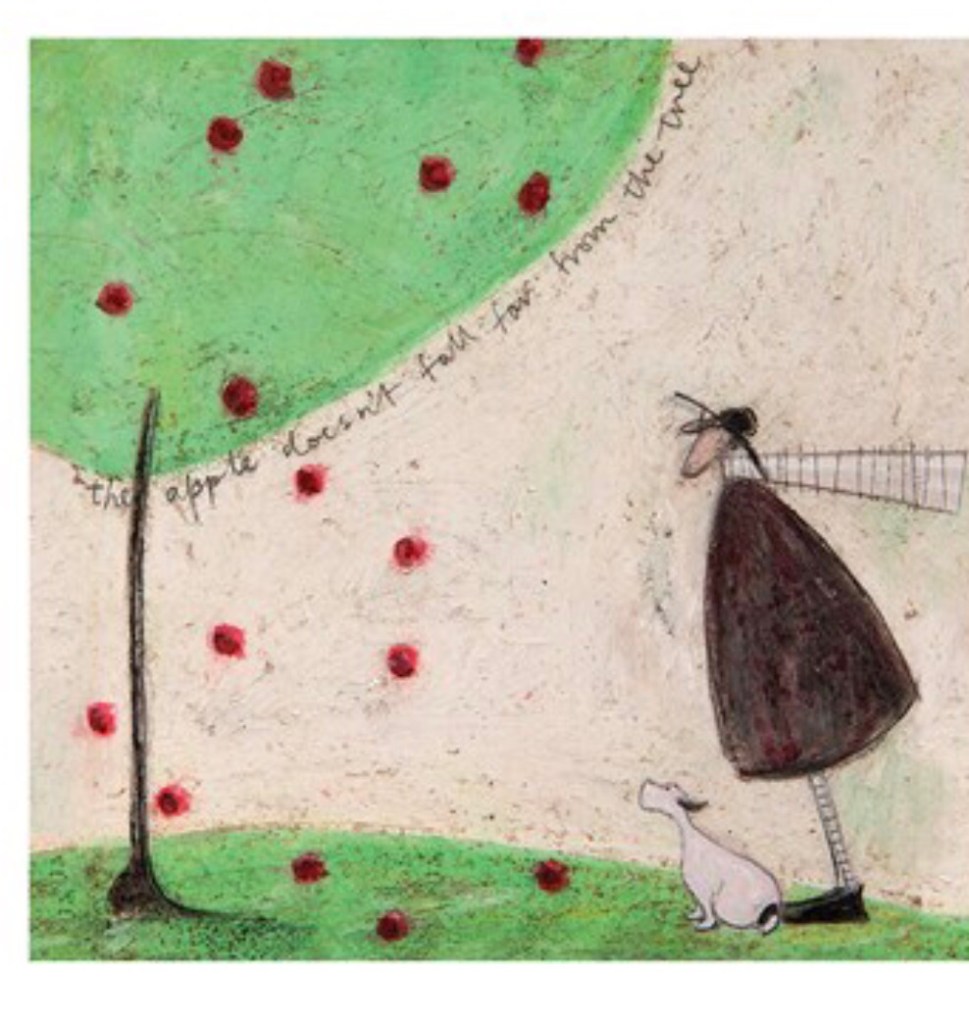
Apples don’t fall far from trees. However, occasionally the soil is not quite right, and the apple must be taken away and planted somewhere else.

It may be easier for us to demonise the Birth Parents and consider them as evil.

But they’re clearly not.

A judge, representing us all, decided they could not look after their child, so he came to live with us. We have decided to trust the system and look after him as best we can.

I’ve no idea how a child in care or one who has been adopted is meant to respond to these cards.

We write occasional return letters giving the most cursory of information.

‘He’s happy and he is safe and he likes school.’

Even this simple, innocuous statement, seems loaded with judgement and condemnation.

There is no social etiquette for this scenario.

Occasionally, the Little Man will turn the information about his past into a collage on his wall. 

He has turned a photo of his Birth Mother into a screensaver.

He has turned a photo of his Birth Parents into a screen case.

He has also ripped every photo to shreds and set them on fire.

We’ve learnt to make a digital copy of absolutely everything.

At the moment, there is nothing in his room or in our home to tell a visitor that he has another family.

This may change tomorrow, or next month or next year, or maybe never.

On one occasion, we got a much larger package than usual.

The package was from Social Services, and contained a large amount of ‘life story work’.

There were photos, reports and letters.

I assume this information had been languishing in a filing cabinet, in a store room, in an office, in a Council Building for some time.

My wife and I  learnt many of the details of the Little Man’s early life.

We suddenly had a couple of baby photos, and some slightly sharper photos of birth family.

The resemblances were clear, and we could see he had his mother’s eyes and father’s hair.

In another scenario we’d have cooed about the likeness and similarities.

We’d have celebrated the strength of DNA and said something about ‘apples not falling far from the tree’.

We learnt he was named after a contestant on a Reality TV Show.

Fly casual! It’s very hard to know when it’s a good time to introduce information about a child’s past. Predicting the response is even harder.

We learnt we’d been pronouncing his name correctly.

This was something of a relief.

The decision to show Letterbox Contact materials to a child is not straightforward.

Birth parents have sent this information.

Does a child not have a right to see it and know it?

But what if it triggers a deep visceral reaction? What if the reaction is so angry that rooms are destroyed, adults are assaulted, and self harm is attempted?

In whose interests are we acting?

It was in the middle of the summer holiday when we received this Lifestory Package.

We decided it was a good time to show The Little Man.

There was no school run in the morning and no routine restricting the time we could spend with him, as we considered what his reactions may be.

This was as good a time as any.

‘We’ve had a letter from Social Workers. It is about you. Would you like to see?’

There was definitely curiosity, but no excitement.

No tears.

Just dry eyes as the information was processed.

Most of us want to be like the rest of us.

The Little Man turned the photos into a little shrine in our bedroom.

That night, he decided he wanted to sleep in our room, and built himself a nest of duvets, blankets and pillows.

This was new behaviour, but we went with it.

As we drifted off to sleep, he began one of his monologues.

To no one in particular, he said;

‘I am here, in my bed, between all my parents.’

Can Foster Carers have a job?

Kid: “Phil, where do you keep going?”

Me: “What do you mean? When?”

Kid: “In the morning, you put on a yellow coat, and you go out of the house.  Where are you going?”

Me: “I am going to work.”

Kid: “And when you come back to the house, where have you been?”

Me: “I am coming back from work.  I go every day from Monday to Friday.”

Kid: “Why?”

Me: “I go to work to earn money to pay for the food, and the WiFi, and the electricity.  I go to work because I said I would, and I go to work because, on most days, I quite like going.”

Long thoughtful pause.

Kid: “What if you don’t feel like going?”

Me: “Sometimes I don’t feel like going, and if I am ill, I wouldn’t go in, but if I don’t go, I’ll be letting people down. Who will teach the kids if I don’t turn up?”

Getting up, getting dressed, and managing a morning routine is an important life skill. I cycle to work, whatever the weather, because I’m too tight to buy a car.

This kid only stayed with us for a few weeks.

He had been in care all his life and had come to stay with us while his regular carer was undergoing some medical procedures.

Inevitably, he had encountered working people before he lived with us.

He was taught by teachers and Learning Support Assistants, and was cared for by Lunchtime Staff.

Cleaners cleaned up after him.

He’d seen people empty the bins in the street where he lived.

He’d been in buses driven by bus drivers.

He had a Social Worker, in fact he had probably had several, and had inevitably encountered a variety of medical staff for routine or specific medical issues.

However, he’d never lived in a home where adults left to go to work, did a shift, and then returned home.

His Foster Carer was of course working because she was being paid to look after him.

However, she was so integral to his life, more like a grandmother than a highly experienced, trained professional, that he had not made the connection.

He’d never considered that the staff at his school, did more or less what I do.

He’d never watched someone leave the house, go to work, and then return several hours later.

Behind every front door in Britain, there is a unique domestic situation.

I think our Foster Households should reflect this diversity.

Foster Households can be working couples with children, single parents, same sex couples, widows, black, white, rich, poor, religious, atheists, and almost certainly Everton fans.

Every household is different. We need our Foster Carers to reflect this diversity. Speedo Mick is a local celebrity where we live.

No one should be discounted, as long as they meet the Assessment Criteria.

And one of the most important criteria must be that a potential carer can meet the needs of the Foster Child as and when they arrive.

If a child needs to go to hospital, you need to be available to take them.

If a child has the opportunity to spend time with their Birth Mum, their Foster Carer needs to be able to make that happen.

If a child’s sleep is disrupted by nightmares or bed wetting, their Foster Carer needs to have the flexibility in their schedule to manage the subsequent emotions and practicalities.

When we started fostering, I was a full time teacher.

My wife worked Part-time for our Council and worked ‘family friendly hours’.

We had two Primary aged children.

Could we manage the needs of a Foster Child?

The answer was yes.

We are a Mum, Dad, two kids, and the occasional pet, all stuffed into a semidetached house. It’s pebble dashed. We converted the garage into a bedroom so that we could foster.

As a teacher I could deal with the 12 weeks that any Foster Child would not be in school.

The flexibility of my wife’s job meant she could take a child to any medical or Foster related appointment.

However, our Social Worker knew we could not care for a preschool child at home all day, every day.

Our Social Worker knew our domestic set-up meant we would not be able to transport a child to school on the other side of the city every morning.

We have had to be flexible to meet the needs of the children who have been placed in our care, but the success of the ‘placements’ has also been due to being ‘matched’ with the right kid.

Matching is crucial to a kid fitting in with a Foster Household.

Our Little Man, who has been with us 9 years, loves phones and devices. When he’s older he wants to run his own phone shop. Employment is good for us and good for society.

Teaching isn’t easy, but it’s been great for my mental and physical health to leave the home every day and go to work.

It’s also been a good role model for the children we’ve fostered.

Regression: Loss will bite you on the bum if you don’t deal with it.

We fostered a little boy who loved watching the ‘baby videos’ of our birth children.

Although technically inferior to the Betamax, the VHS recorder was a solid piece of technology that everyone aspired to owning in the 1980s. We’ve still got ours.

He learnt to use the old VHS recorder and spent hours absorbed in the traditional upbringing of his foster siblings.

He’d watch the grainy images of bath time, walks in the park, first birthdays and Christmases, Christenings, and visits from Grandparents again and again and again.

It was all pretty mundane and would be familiar to most families.

But to him, it was a magical world.

‘I would like a baby.’

We were quite used to random requests, but were initially unsure how to respond to this.

Did he mean he wanted a sibling?

That’s was going to be beyond our remit and abilities.

A short discussion ensued and we began to understood that he wanted some sort of doll.

This we could achieve.

We put a few requests out onto our Facebook Support groups and were fairly soon inundated with offers of Barbies, Cindys, the entire cast from Frozen, and a couple of Asda own brands.

Apparently, none of them were good enough.

The interest continued but neither Toys ‘R’ Us, Smyths or even B&M had what he wanted.

Meanwhile, this ‘want’ was becoming a ‘need’, and fast developing into an obsession.

Amazon came to the rescue.

Hours of scrolling led us to what he wanted; ‘A baby newborn silicone doll £65.99. Next day delivery’.

This isn’t John, but he looks pretty similar. Playing and make believe is therapeutic. Never underestimate the healing power of using your imagination.

This was not an inconsiderable sum, but the desperation convinced us that we should buy it.

He then announced his new baby needed a buggy, clothes, nappies, bottles, sterilisers and all the other relevant newborn paraphernalia.

Toy versions would not suffice.

Further appeals to the Facebook Massive secured us everything ‘new baby’ needed.

Primark’s 6-12 month range supplied anything that was missing.

‘New Baby’ was named John.

He absolutely had to be treated like a real baby.

He had to be sat up, cuddled, fed, changed and put to bed.

If he cried, he had to be settled with cooing and appreciative noises.

John’s favourite nursery rhyme was ‘Row row the boat, gently down the stream…’.

On sunny days, John was taken to the park in the Maclaren’s buggy we had been lent.

Occasionally, on the journey, John was sniffed, to see if his nappy needed changing.

If all was well, he was given a reassuring cuddle, and  had his blanket tucked back in.

It’s a friendly community where we live, and passers by would smile and nod at the sight of a big brother taking his newborn sibling for a walk, with a proud dad walking behind.

How little did they know.

John became one of the family.

It soon became quite natural for me to balance John on my knee or ‘mind him’, whilst our foster son had to ‘nip to the loo’ or carry out any other unavoidable task.

We chatted to more experienced Foster Carers and did some googling.

Without any help from us, our Foster Son had discovered something called ‘regression’.

If you do a Google image search of ‘Regression’, you get this graph. I have no idea what it means.

One day, whilst taking John to the swings, the Little Man asked;

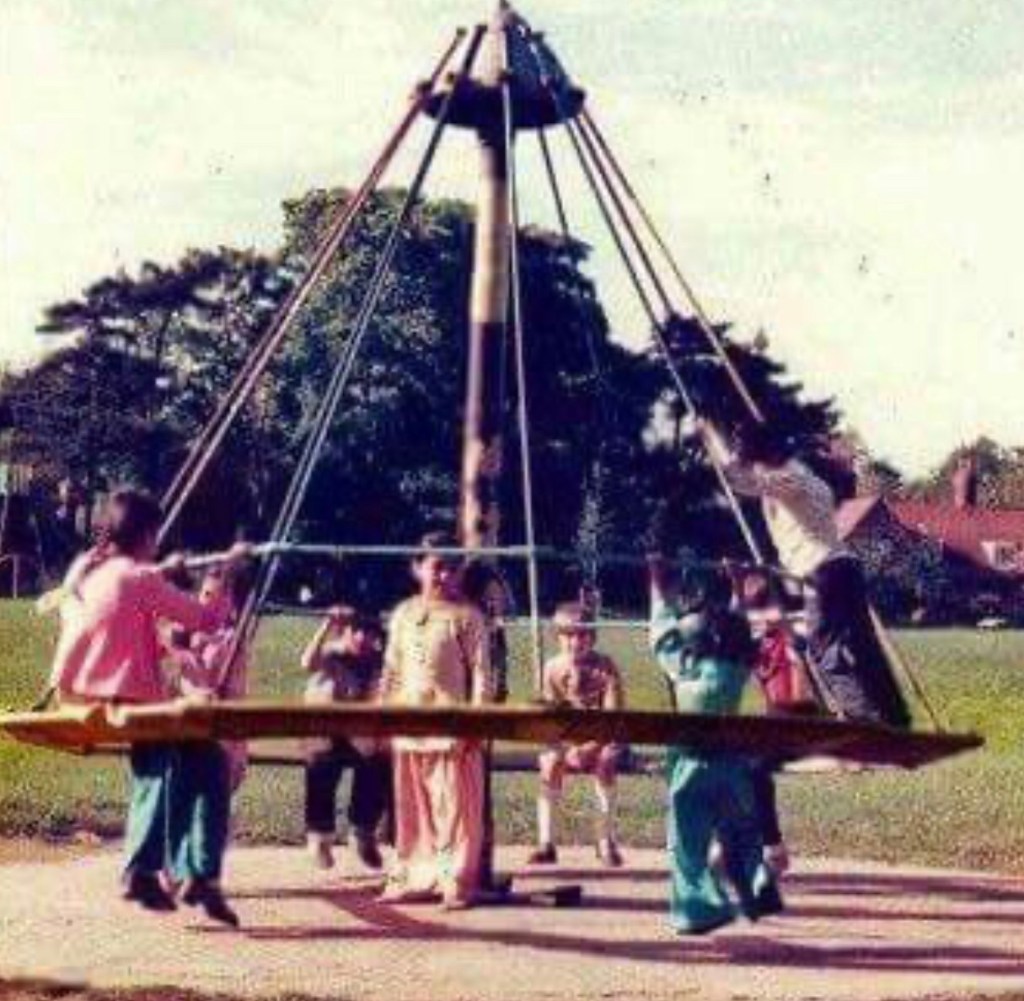
If the sugar rich diet of the 1970s didn’t knacker your teeth up, there was a fairly good chance that the infamous ‘Witch’s Hat’ down the Swings and Slides would do the job. Viciously exciting!

 “Did my Mum and Dad take me to the park?  Did my Mum and Dad sing to me? Are there videos of me as a baby?”

These were questions to which we had no definite answers, but in all likelihood the responses were an emphatic ‘no’ on all counts.

When he arrived at our house it was fairly clear he’d never experienced a trip to the park, could barely talk, and was unfamiliar with birthdays, Christmas or any other rites of passage.

Through Baby John, our little man was living the life that had been denied him.

It was both incredible and beautiful to watch.

I don’t know how he knew that this would restore the years that were characterised by neglect rather than care, but somehow he knew.

He just knew.

All we had to do was help.

Then, one day, We discovered John shoved under the bed.

Later he was relegated to the loft.

The final ignominy came when he was given away to Charity.

‘I don’t need that anymore. It’s for babies.’

The healing had been done.

Will my house get trashed?

Have you ever seen Shirley Valentine? The film about a bored housewife from Liverpool, who has a midlife crisis and goes on holiday to Greece

She begins a relationship with a local lothario, played by Tom Conti, but is ashamed of her body.

Tom tries to reassure her. He says her stretch marks and other natural ravages of time are beautiful, and make her who she is.

Shirley Valentine could foster. She has a spare room and a deep desire to make a difference. Her angry, inflexible husband would be a barrier to a ‘positive assessment’.

You don’t get stretch marks from fostering.

But your home and your property may get ravaged.

Our woodwork is chipped, and in some places gouged.

We have rubber bumpers glued to the walls to protect them when doors are slammed.

The kitchen door needs rehanging, again.

Phones and iPads have been launched in both anger and frustration.

Some damage has proved to be prompted by naivety rather than malice.

On one accession, our birth son could not find his iPhone.

We assumed it was somewhere in the house, and would turn up.

As my wife was rummaging through the freezer looking for tea, she discovered a Tupperware container containing frozen water.

Deep in the frozen water was our son’s iPhone.

We knew it had been placed there by our foster child.

Had he done this to spite our son? Was he jealous? What was he trying to tell us?

We asked him, but as anticipated, he ran off to his room, denying any knowledge of any phone, the freezer, Tupperware or water.

Our daughter solved the mystery.

It was plain to see in the Foster Child’s YouTube history.

He had recently searched ‘What to do when your iPhone freezes’

Yes, that’s right, he’d given this question a very literal interpretation, and frozen the first iPhone that came to hand.

‘Attachment Disorder’ can look very similar to autism. There can often be a very literal interpretation of situations.

He was not being naughty, he was being curious!

We thought the phone was ruined but at least the motivation was not as serious as we’d first thought.

Remarkably, the phone thawed out and worked perfectly until the end of contract.

On another occasion, the same foster kid received a ‘pay as you go mobile’ from Grandad for his birthday.

He had an obsession with phones and we’d thought he’d be delighted.

And he was.

For a couple of hours.

The phone was in his hands by 10.00am.

By 2.00pm he was smashing it to crap with a hammer.

Did he hate the phone? Did he hate Grandad? Did he hate birthdays?

No, he hated himself.

I’ve talked about self-esteem in other blogs. If you can convince a child that they’re worthy of love, you’re doing brilliantly.

We worked out that the ‘gift’ just did not fit with his self image.

As his parents had rejected him, so he had to reject anyone or anything that suggested ‘love’.

He could not cope with anyone or anything that suggested he was loveable.

It took us a while to work that out, but it’s helped us cope with Christmas, birthdays and any other occasion when we might show obvious love and affection.

It has got better.

When the red mist comes down, which could be triggered by absolutely anything, we have learnt to move as much as possible out of harm’s way, and let the anger burn out.

A good meltdown would involve the throwing of cushions and pillows.

If there were no soft furnishings to hand, anything that could be trashed would be trashed.

On one occasion, after a fraught day at school, he was ‘proper fuming’ to use the local vernacular.

Kitchen chairs were being knocked over with a satisfying crash and his Primary aged fists were pummelling the table, the floor and the walls.

My wife and I were standing back and would only intervene if he was in danger of hurting himself.

But we’d made an error.

In the middle of the table was a bottle of juice, or ‘squash’, if you’re southern.

It was Apple and Blackcurrant, a colour combination that is known to stain.

And the lid had been left off.

‘This will take some cleaning’ was the thought in both our heads.

As our Little Man’s anger raged on, he spotted the bottle.

We actually shop at Asda and Tesco’s or Aldi. Sainsbury’s is miles away. Foster Carers can shop anywhere they like.

But then he stopped, and still seething with rage, he found the lid, and screwed it on as tight as he could.

Back on the table, rather like a rugby ball waiting to be converted, the bottle was then launched across the kitchen by a well aimed punched.

We were amazed.

This was the first time the Little Man had ‘self regulated’ during a meltdown.

As was often the case, he then calmed, and within minutes was watching Tracey Beaker, as if absolutely nothing had happened.

Stopping, and pausing, and minimising the damage was a massive step.

Meltdowns didn’t end.

There is still damage.

But every day that kid feels a bit safer and is a little bit calmer.

In my mind, what you see as a Carer for a traumatised child is ‘fear masquerading as anger’.

And, let’s face it, some kids have got a lot to be scared of and have a a lot to be angry about.

If you’re precious about stuff, and live in a show home, you probably want to give fostering a big swerve. If you want to make a difference, contact me or your Local Council.

What’s fostering and what’s adoption?

“Being adopted will be good. There’ll be no more Social Workers wanting to know my business. I can be in all the photos at school, and I can be on Snapchat and Tik Tok like normal kids. And when we go on holiday, I won’t need a special letter to say who I am.”

Most kids who get adopted are pretty young.

I’m not big on statistics, but 75% of kids who get adopted are yet to start Reception.

This kid was 9, so significantly older than a typical adoptee.

He’d been in and out of the Care System all his life and had a pretty good understanding of what adoption meant.

We had been fostering him for about three years.

He arrived as a Short Term Placement (0-2 years), and then had become Long Term (2 years +).

I think this status was more or less irrelevant to him, when he made it clear he wanted to be a more permanent member of our family.

He’d discovered a Sharpie (other permanent markers are available) and had added a picture of himself to a family photo. 

A very moving conversation ensued.

It was a rookie error on my part. Left unattended a foster kid found a Sharpie permanent pen, smashed the glass out of a family photo, pulled the frame off and draw a picture of himself.

Explaining that you want to join someone else’s family is a very difficult thing to do.

You’re making yourself very vulnerable to rejection.

Adding himself to a family photo was how he chose to show his feelings.

The implications for us were also not insignificant.

As Foster Carers, there is always an element of ‘temporary’, and a feeling that you don’t have ‘full responsibility’.

Even if a child is with you on a permanent basis, Social Workers will still play some sort of role.

Day to day, or even month to month, you may well make all the decisions, but ultimately The State has the final say.

The child will still have their own surname, and will almost inevitably become a ‘Care Leaver’ sometime in the future.

They may stay in touch but they may not.

There are also significant financial implications.

Foster Carers have to do mandatory training, meet various standards and are expected to provide a level of care that is arguably above and beyond that of a birth parent.

I would advise parents generally, and Foster Carers in particular, to own absolutely no Permanent Felt Tips.

No one is quite comfortable discussing this but Foster Carers get paid. They don’t earn a fortune, but they get a income for looking after a vulnerable child.

Foster Carers work in close conjunction with Social Workers.

Typically, adopters are on their own.

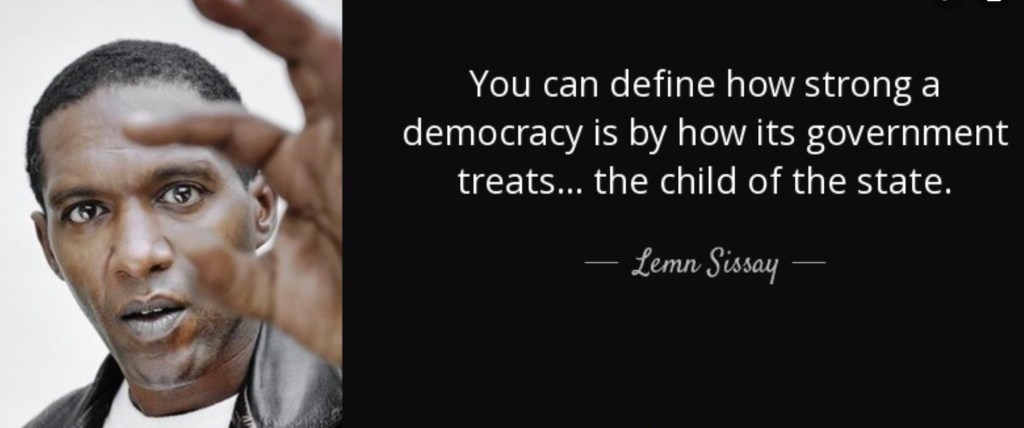
Lemn Sissay is a great Poet. He had a horrific time in the Care System. ‘Family is the privilege everyone should be able to take for granted’.

Adopters are not paid.

Legally, their adopted child is as much their child as a birth child.

Many adopters have experienced infertility, have visited medical specialists, have possibly had unsuccessful IVF, have considered whether to pay to have more IVF, have decided against it, and then reached the conclusion that they are not going to have children naturally.

They grieve.

They then begin to explore adoption.

Some adopters are same sex couples, and some are single people.

They will have contacted an Adoption Agency, been repeatedly visited by a Social Worker, and gone through a rigorous assessment process.

Eventually, a group of independent experts will decide whether they are fit to be parents.

They will then be matched with a child or children.

What can take some people 9 months and very little thought, can end up taking years of high emotion and anguish.

Reaching the point of bringing your children home can be a long and arduous journey.

And then you have to start parenting!

I think it’s quite unusual for Mainstream Foster Carers to adopt.

We are aware that our journey has been very different from many other adopters.

We knew our son had had a very difficult time whilst in care.

We knew that he had absolutely no family who could care for him.

We knew he wanted to be adopted into our family.

Kids in care are surrounded by numerous professionals, including Social Workers, Teachers, Teaching Assistants, Sencos and Foster Carers. This kid is surrounded by his family.

We knew we were relieving the State of a significant financial and bureaucratic burden, and we knew that no one would want to describe a child in such a way.

But we wanted this to work.

Whilst being fully committed to our son, we knew we’d need help and we were going for Permanent with a very big ‘P’.

We told our Local Authority that we would need some financial support, some Post Adoption Support, some therapy, some help with Speech and Language, some Life Story work and that possibly, he would never be able to live independently.

A few emails later, they agreed.

We resigned as Foster Carers, got approved as Adopters, got matched with our son, who had been living with us for some years, and then he became legally ours.

We went to Pizza Express and ate as much as we could as a celebration.

I don’t know if there are success criteria for an adoption.

I do know that adoption does not solve issues of attachment and abandonment.

Neglect and all varieties of abuse leave a legacy that generally last well into adulthood.

I think there are about 80,000 kids in the Care System in England. Some will live with family members and some will live with Mainstream Foster Carers.

Our adopted son has recently begun to ask when we will foster again.

He thinks we’d be good at it, and he doesn’t want to be the youngest.

There are worse reasons for looking after a kid.

Food issues and traumatised kids

Rather naively, we thought knowledge of Peppa Pig was universal.

We had advanced warning from our Social Worker that a three year old would be arriving later that day.

Perfect skin, confident eye contact, nicely coiffured hair, good teeth and a generally healthy complexion are all things that many of the kids we’ve fostered have not had.

We felt a little bit smug about our preparations.

His room was ready, my wife and I had had plenty of sleep, and our birth kids (then 6 and 8) were buzzing with excitement.

We’d set a place at the table, we’d bought a Peppa Pig cutlery set, and my wife, a very good cook, had prepared ‘kid friendly’ spaghetti bolognese – lots of meat, not too many obvious vegetables, grated cheese and lots of pasta.

Our birth kids had already remarked that the Little Fella didn’t seem to recognise any of the TV programmes they’d shown him.  We supposed that there was no TV where he lived.

We called everyone for tea and the Little Fella dutifully followed the big kids into our extended kitchen.

This was a familiar routine for our birth children.

A rectangle table, the right number of bowls or plates, knives, forks, spoons, a jug of water, juice (squash if you’re Southern), unwritten rules about who sat where, serving bowls full of food dotted around the table, and everyone encouraged to take the food they needed, and possibly a little bit more.

If you were near the jug, you were in charge of drinks.

It was hard to tell whether the Little Fella was confused or simply overwhelmed.

He stood rooted to the spot, staring at the floor.

We asked him where he wanted to sit.

We asked him if he liked Spag Bol.

Did he like Peppa Pig?

We got no answers, or even any eye contact.

The Little Fella just stared at the floor.

We searched our cupboards, fridge and freezer.

Tinned beans, bread, peanut butter, cereal, frozen chips and any other fairly ordinary foods were all greeted with the same wide eyed indifference.

We even used the ‘sing song voices’ we had learned about on our P.A.C.E. Training.*

Unsure what to do, we just carried on eating our tea, occasionally trying to engage the ‘kid in the room’.

Family Teas are fairly quick affairs in our house, and our big kids soon finished and then disappeared back to screens and homework.

My wife and I began to clear up, and were loading the dish washer in that choreographed manner of an established couple.

With our backs turned, we sensed movement.

The Little Fella had moved.

He’d moved quickly.

He’d opened the fridge, seized an unopened Four Pint of Milk in a plastic bottle, bit the plastic lid off, ripped the foil off with his teeth and was glugging away.

The milk was pouring down his top, down his trousers and making a puddle on the floor.

But some of it was going down his throat.

My wife and I were unsure about what to do.

I get sent this picture every couple of weeks. I don’t like Fosters but I do like dogs. As long as they are kid friendly, Foster Carers can have pets.

Our six year old, who had reentered the kitchen on hearing the commotion, was the quickest to react.

‘In our house we have cups’, he said quite matter of factly.

He fetched a cup from the cupboard, poured the remains of the milk, mimicked drinking, and handed the cup to the Little Fella, with an encouraging nod.

The Little Fella drank from the cup.

Yeah, he wasn’t an expert, and lots of the milk dribbled out the sides, but it wasn’t bad for a first go.

And I really think it was his first go.

Everything about our domestic set up was completely and utterly alien to this kid.

We learnt by trial, error, and observation, that he had survived without encountering mealtimes, tables, chairs, cups, cutlery, or Peppa Pig.

I found this photo on the internet. The reality was much messier, but there’s no point in crying over spilt milk when we should be crying over neglected children.

But, he knew about milk, and he knew it kept you alive.

We discovered over the next few days that he also knew about takeaway chips, as opposed to frozen ones that you cooked.

In fact, if it came in a paper bag and was greasy, he seemed far more comfortable.

We worked out that he’d lived off milk and the occasional bounty of chips, pasties and sausages.

And so, to begin with, that’s what we fed him.

We decided we’d tackle the ‘5 fruit and vegetable portions a day’ sometime in the distant future.

Our first goal was to convince him that in this house, he’d never be hungry again.

We let him pile his plate as high as he liked.

He would sometimes go to bed with ‘Noodles, no sauce, Nutella on white bread and a cup of milk please Bill’.

Who would have thought that a combination of carbohydrates and E-numbers would be so irresistible.

Within a month, his favourite food had become ‘that beans and sausages’ from a tin, with a load of broccoli.

When the microwave pinged he’d go delirious with excitement.

Within a few years, the noodles, white bread and Nutella were often left untouched, and we threw them away each morning.

After a few more years, he went to bed without any food at all, confident that the kitchen and its full cupboards, would be there in the morning.

I’ve learnt that Holocaust survivors and POWs often never recover from the starvation they’ve suffered, and always have an uneasy relationship with food. I think it’s similar with some kids who have been neglected.

*P.A.C.E training is a form of therapeutic parenting. You learn to manage the tone and rhythm of your voice to avoid sounding confrontational.

Mother’s Day: Which Mum do I need to send a card to?

The Card Industry doesn’t deliberately set out to make our life difficult, but it does.

I’m sure there’s some deep and wonderful meaning behind the original Mother’s Day, but it’s a bit of a minefield if you foster or adopt.

Being curious is all part of growing up

Whether it’s adverts in shops or a simple craft activity at a Playgroup or school, making a card for someone called ‘Mum’ is tricky if you don’t live with your Mum, you don’t know your Mum, or you only see her for supervised contact once a week or once a year.

How are you supposed to feel about a Mum who may have mistreated you?

It’s also tricky for your ‘current maternal scenario’.

What is the card etiquette with regard to the person who is ‘currently mothering’ you?

Do you make a card but address it to ‘My Foster Mum’ or ‘My SGO Mum’ or ‘Helen’?

Do you make breakfast in bed for the lady who looks after you, when your safeguarding plan states: ‘You should not be in each other’s bedrooms, and should be appropriately dressed at all times’.

And how does it feel to be a Mum separated from your children?

I know I’m drifting away from Mother’s Day, but here are a couple of anecdotes about me, a male, that may put a bit more meat on this particular bone.

‘No one loves me but my mother, and she could be lying too’. I like the Blues and I love BB King.

We have an adopted son.

He calls me Phil in the house.

He calls me Dad when we’re out and about.

For a long time he called me ‘Bill’, because he couldn’t say ‘Phil’.

We went to France and he called me Philippe.

He found this hilarious and still calls me Philippe if we ever have croissants for breakfast.

The same child also said to me one Father’s Day:

‘You’re the best Dad I’ve ever had.  The others have been shit’.

The same son always calls my wife ‘Mum’.

Hurrah for the endless opportunities offered by computer software.

Sometimes he will refer to his ‘Tummy Mummy’ or his ‘other Mummy’ or will use her ‘first name’.

He’s had other mother figures too.

Like many kids, he bounced around in care for some years before he ended up with us.

Occasionally, he will talk about ‘a woman where I lived…I don’t know her name’.

I’d love to end this blog with a pithy, wise, statement that will make us all feel better.

But I can’t.

The truth is, for each kid and each family, we’re making it up as we go along, managing a wild and erratic range of emotions and doing our best, each day.

I love my Mum. She adopted me into her family. She loves me like her birth child, and she is the best Mum.

However you got your mother, and whoever you’re mothering, enjoy today.